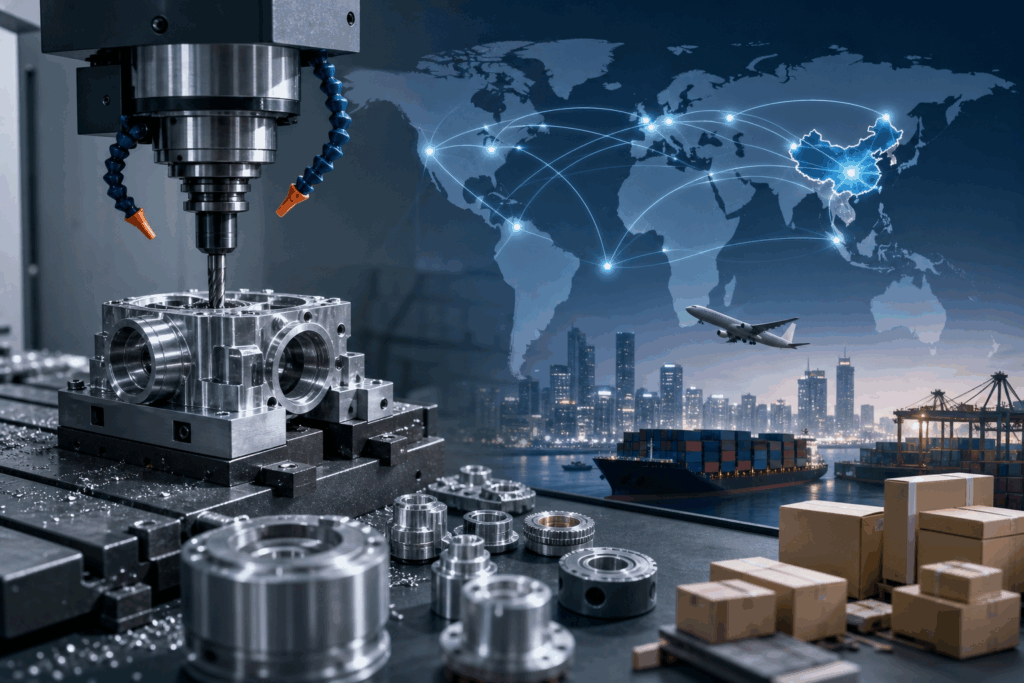
Whether you are a startup trying to get your first physical product off the ground or a large enterprise managing a complex parts procurement process, one challenge stays the same: finding a manufacturing partner that can actually keep up with your needs. Quality, speed, cost, and flexibility all have to align at once, and that is a tough combination to find in one place.
That is a big part of why so many companies, from early-stage product teams to Fortune 500 procurement departments, have turned to China for CNC machining. It is not just about lower prices. The manufacturing infrastructure in China, particularly in industrial hubs like Shenzhen, has matured in ways that make it genuinely competitive on every front that matters to a supply chain.
What Makes CNC Machining So Central to Modern Supply Chains
Before getting into why China specifically, it helps to understand what makes CNC machining such a critical piece of the puzzle for so many industries.
CNC (Computer Numerical Control) machining covers a family of processes where computer-programmed machines cut, mill, turn, and shape raw material into finished parts. The process works across metals like aluminum, stainless steel, titanium, and brass, as well as engineering plastics and composites. It handles everything from simple brackets and enclosures to highly complex components with tight tolerances measured in hundredths of a millimeter.
What makes it so valuable in a supply chain context is repeatability. Once a part is programmed and validated, it can be reproduced consistently across hundreds or thousands of units with the same dimensional accuracy every time. That predictability is what procurement teams and engineers depend on when they are sourcing parts across time zones and borders.
Why China Has Become the Default Choice for So Many Buyers
China’s dominance in precision manufacturing did not happen overnight. It has been built over decades through significant investment in machining equipment, workforce training, and quality systems. Today, cities like Shenzhen are home to facilities that operate fleets of 100 or more CNC machines, hold certifications like ISO 9001, AS9100D, and IATF 16949, and serve clients across North America, Europe, and Asia-Pacific from a single location.
For buyers, that level of consolidation is a real advantage. Instead of coordinating with a collection of specialized shops, you can work with one manufacturer that handles CNC milling, turning, sheet metal fabrication, die casting, 3D printing, and surface finishing under one roof. That simplifies everything from quoting to logistics to quality accountability.
Cost is still a factor, of course. Labor and operational costs in China allow manufacturers to price custom parts at a point that simply is not reachable in most Western markets, especially for mid to high volume runs. But for many buyers today, cost is actually secondary to the combination of capability, capacity, and communication that top-tier Chinese manufacturers now offer.
How It Works in Practice for Startups
For a startup, the biggest challenge with custom manufacturing is the early stage of the relationship. You often have a CAD file, a limited budget, and a hard deadline tied to an investor demo, a trade show, or a first production run. You need a manufacturing partner who can move fast, flag design issues before they become expensive mistakes, and deliver parts that actually match your specs.
This is where the Design for Manufacturing (DFM) review process becomes so important. Good China-based CNC suppliers offer free DFM analysis as part of the quoting process. Engineers on their side review your design, flag features that are difficult to machine or unnecessarily expensive, and suggest adjustments that can cut cost without compromising function. For a startup, that kind of feedback before a single part is cut can save significant time and money.
Turnaround times have also improved considerably. Prototypes can often ship within three to seven days. That kind of speed lets product teams iterate quickly, which is critical in early development when the design is still evolving.
How It Works in Practice for Enterprises
For larger organizations, the supply chain considerations are different. You are not just sourcing a few prototype parts. You are managing recurring production orders, vendor qualifications, inspection documentation, and supplier relationships across multiple product lines. Reliability and consistency matter more than anything else.
This is where manufacturers like China CNC Machining specialists with full certifications and structured quality systems prove their value. A facility that holds ISO 9001, ISO 13485 (for medical devices), and AS9100D (for aerospace) is not just displaying certificates on a wall. Those certifications require documented processes, regular audits, traceability on every batch, and formalized quality control from material receipt through final inspection. For an enterprise procurement team, that kind of documentation is what makes a supplier auditable and trustworthy at scale.
Capacity is the other piece of the puzzle for enterprises. A supplier with 100 or more CNC machines and Swiss-type lathes can absorb large, consistent order volumes without the scheduling instability that plagues smaller shops. When you place a production run of 5,000 or 50,000 parts, you need confidence that it will not get bumped by a competing order. That kind of capacity assurance is only possible at a certain scale of operation.
The Industries That Rely on It Most
The reach of China-based CNC machining across global supply chains shows up clearly in the industries it serves. Automotive suppliers use it for engine components, transmission parts, and brackets where dimensional tolerances are tight and material certifications are required. Aerospace manufacturers depend on it for structural components machined from titanium and aluminum alloys where any deviation from spec is a safety issue.
Medical device companies source CNC-machined housings, implantable components, and surgical instrument parts through facilities that hold ISO 13485 certification. Consumer electronics brands, including some of the biggest names in the industry, rely on Chinese CNC manufacturers for enclosures, heat sinks, and precision hardware that goes into everything from laptops to cameras.
The robotics and semiconductor industries have also become major users, sourcing highly precise components that need to meet exacting dimensional standards across high production volumes. The breadth of industry coverage is a sign of how deeply China CNC machining has embedded itself in the global manufacturing ecosystem.
What to Look for When Choosing a Partner
Not every CNC supplier in China is the same. The quality, communication, and reliability vary significantly, and choosing the wrong partner can set a project back in ways that are hard to recover from. A few things to evaluate:
Certifications matter. Look for ISO 9001 at minimum, and additional certifications relevant to your industry. A supplier serving aerospace, medical, or automotive clients should hold AS9100D, ISO 13485, or IATF 16949 respectively.
In-house capability is worth verifying. A true direct manufacturer owns its equipment and employs its own operators and engineers. Suppliers who broker work to subcontractors introduce quality and timeline risks that are hard to manage from a distance.
Engineering support separates good suppliers from average ones. A team that reviews your design, catches problems early, and communicates clearly in English makes the working relationship far smoother than one that just runs the job and ships the parts.
Minimum order flexibility is increasingly important, especially for startups and teams running pilot production. Look for suppliers who can handle small batch runs without punitive pricing, and who can scale with you as volumes grow.
About Yijin Solution
Business: Yijin Solution
Spokesperson: Gavin Yi
Position: CEO
Phone: +1 626 263 5841
Email: [email protected]
Location: 760 NW 10th Ave, Homestead, FL 33030
Website: http://yijinsolution.com/
Google Maps Link: https://maps.app.goo.gl/TbnqMpxoinnottN7A
Bringing It Together
The reason China CNC machining has become such a foundational part of so many global supply chains is not a single factor. It is the combination: advanced equipment, broad material and process capability, certified quality systems, competitive pricing, and the logistical infrastructure to ship reliably to buyers anywhere in the world.
For startups, it opens the door to production-quality parts at a stage when budget and speed constraints would otherwise limit what is possible. For enterprises, it provides the scale, consistency, and documentation that modern supply chain management requires.
The manufacturing gap between what was available locally and what is accessible from China has closed significantly over the past decade. For most companies sourcing custom precision parts today, the question is not whether to consider Chinese manufacturers. It is how to identify and qualify the right one.
 Loren Hursterer is the kind of writer who genuinely cannot publish something without checking it twice. Maybe three times. They came to expert analysis through years of hands-on work rather than theory, which means the things they writes about — Expert Analysis, Latest Technology Updates, Mental Health Innovations, among other areas — are things they has actually tested, questioned, and revised opinions on more than once.
That shows in the work. Loren's pieces tend to go a level deeper than most. Not in a way that becomes unreadable, but in a way that makes you realize you'd been missing something important. They has a habit of finding the detail that everybody else glosses over and making it the center of the story — which sounds simple, but takes a rare combination of curiosity and patience to pull off consistently. The writing never feels rushed. It feels like someone who sat with the subject long enough to actually understand it.
Outside of specific topics, what Loren cares about most is whether the reader walks away with something useful. Not impressed. Not entertained. Useful. That's a harder bar to clear than it sounds, and they clears it more often than not — which is why readers tend to remember Loren's articles long after they've forgotten the headline.
Loren Hursterer is the kind of writer who genuinely cannot publish something without checking it twice. Maybe three times. They came to expert analysis through years of hands-on work rather than theory, which means the things they writes about — Expert Analysis, Latest Technology Updates, Mental Health Innovations, among other areas — are things they has actually tested, questioned, and revised opinions on more than once.
That shows in the work. Loren's pieces tend to go a level deeper than most. Not in a way that becomes unreadable, but in a way that makes you realize you'd been missing something important. They has a habit of finding the detail that everybody else glosses over and making it the center of the story — which sounds simple, but takes a rare combination of curiosity and patience to pull off consistently. The writing never feels rushed. It feels like someone who sat with the subject long enough to actually understand it.
Outside of specific topics, what Loren cares about most is whether the reader walks away with something useful. Not impressed. Not entertained. Useful. That's a harder bar to clear than it sounds, and they clears it more often than not — which is why readers tend to remember Loren's articles long after they've forgotten the headline.